4 Sep 2026
SOURCE: CPF Board

Congratulations on reaching retirement! Whether you've stopped working, cut back your hours, or kept going in a different career path altogether, this stage comes with plenty to think through.
From making the most of your CPF LIFE payouts and managing your housing and healthcare needs, to protecting your savings from scams and making sure your wishes are carried out after you pass on, here’s what you need to know about retirement as you reach this exciting phase of life.

Chances are you already had some idea of what retirement would look like before you got here. This is a good point to check whether that's actually panned out, and whether it still fits your needs.
Upon retirement, some retirees feel more comfortable spending more freely, while others prefer to save and hold on to what they have. Both approaches are understandable.
What matters is whether you are using your savings in a way that supports the retirement you want, while keeping enough for future needs.
Using your savings in retirement
For most of your working life, the goal was to save more, spend less, and build enough for retirement. Now that you are in retirement, those savings are meant to support this stage of life and not be simply left untouched.
This is worth keeping in mind because some experiences are easier to enjoy while your health and energy allow for them. These could include:
· New experiences with loved ones
· Travelling to new places
· Using your savings to improve your daily life
However, this fact alone is not an invitation to spend without care. Keeping some savings for unexpected expenses, such as an emergency fund or for a specific future need, is a sensible choice, even in retirement.

Your CPF LIFE payouts already form the backbone of your monthly retirement income. Still, it is worth understanding how these payouts work and what happens to them after you pass on.
CPF LIFE premiums and your Retirement Account (RA)
The savings in your RA are used to pay for the CPF LIFE premium, which then gives you monthly payouts for as long as you live.
You may then wonder about the interest your money earns. Your CPF LIFE premium continues to earn CPF interest, which is factored into your monthly payouts. In CPF LIFE, this interest is pooled to support lifelong payouts.
How CPF LIFE pays you for life through risk pooling
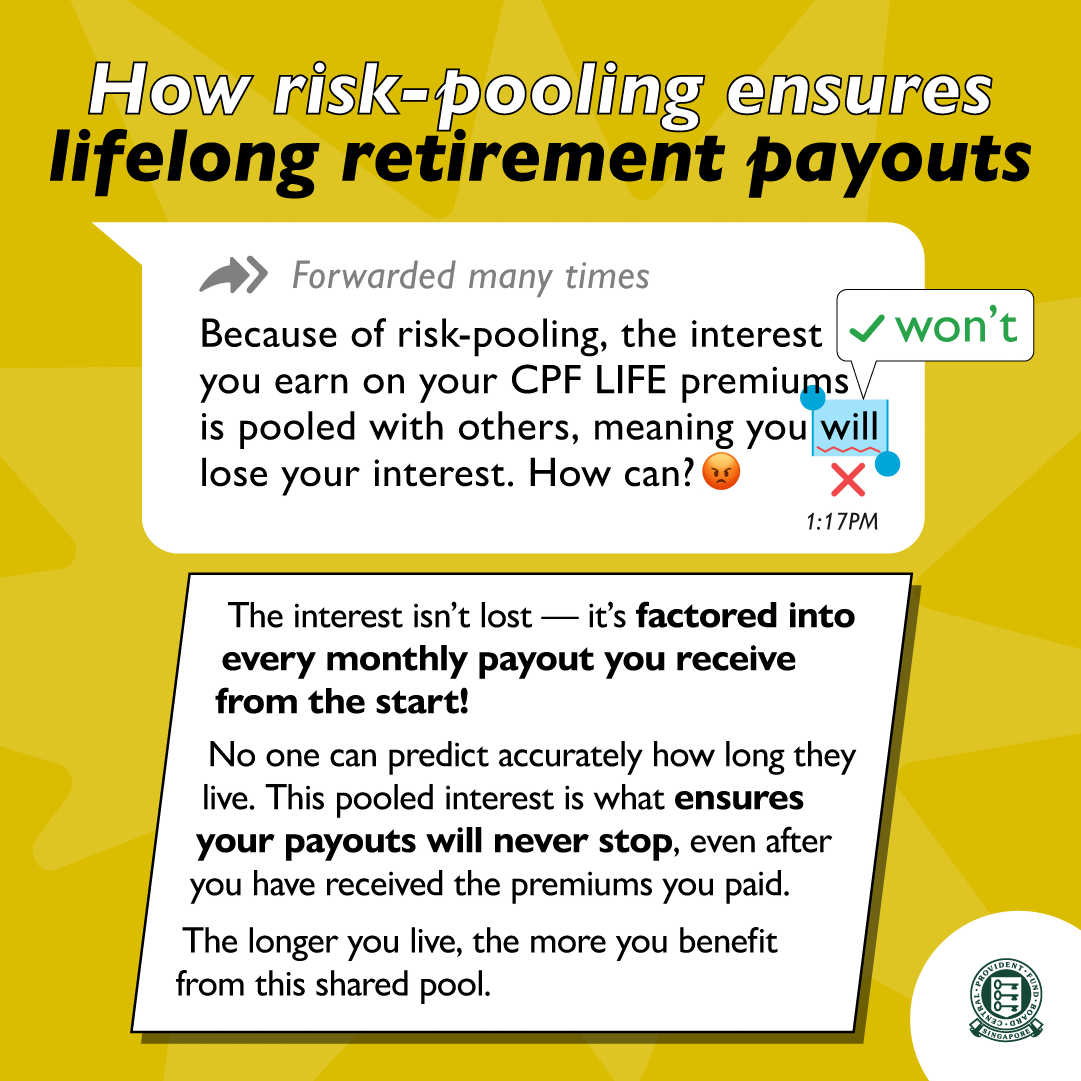
Nobody knows exactly how long they will live. This makes it difficult to know how much to set aside for retirement, especially if you want your savings to last for life.
CPF LIFE helps address this by pooling the interest earned on CPF LIFE premiums across a large membership. This spreads the risk of some members living longer than expected and allows members to receive monthly payouts for as long as they live.
Risk pooling does not mean that you lose the interest earned on your CPF LIFE premium. The interest is pooled with that earned on other members’ CPF LIFE premiums and factored into your payouts. This supports lifelong payouts, including after your premium balance has been depleted.
If you live a long life, you may receive more than the amount you originally contributed. Once the sum of your payouts exceeds the dollar amount of premiums originally committed, any further payouts are effectively drawn from the pooled interest.
What happens to your CPF LIFE premiums after you pass on
If you pass away before your CPF LIFE premium is fully paid out, any remaining premium, together with your remaining CPF savings, will be paid to your beneficiaries in cash.
In general, CPF LIFE premiums are paid out either through monthly payouts during your lifetime, or as any remaining unused premium to your beneficiaries after you pass away.

Even after your CPF LIFE payouts have started, there's still room to grow them further. A few simple steps can increase what you receive each month.
Defer your CPF LIFE payouts
Even if you're already receiving CPF LIFE payouts, you can choose to pause them and defer until age 70. Each year you defer increases your payouts by up to 7%, up to a maximum of 35% if you defer the full five years.
This is worth considering if you have other income from work or investments to cover your expenses. If you rely on the payouts for your current expenses, continuing to receive them may suit you better.
Use the Retirement Payout Planner to defer your payouts and see how different choices affect what you'll receive.
Change your CPF LIFE plan to Standard or Escalating Plan
If you joined CPF LIFE when it first launched in 2009, you may still be on one of the original plans: Basic, Balanced, Plus, or Income. Under these plans, extra interest earned on the first $60,000 of your CPF balances is credited to your RA and factored into your monthly payouts. Once your balances fall below $60,000, both your monthly payouts and extra interest will decrease.
If you're on one of these original plans, you can switch to either the Escalating or Standard Plan at any time. The Escalating Plan gives you payouts that grow over time, while Standard keeps them level.
Before making the switch, take note that once you change to the Standard or Escalating Plan, you cannot change back to your original plan. Also, all your RA savings, including the premium refunded from your original plan, will be deducted as CPF LIFE premium when the new plan is issued to you.
Matching Government grants with the Matched Retirement Savings Scheme (MRSS)
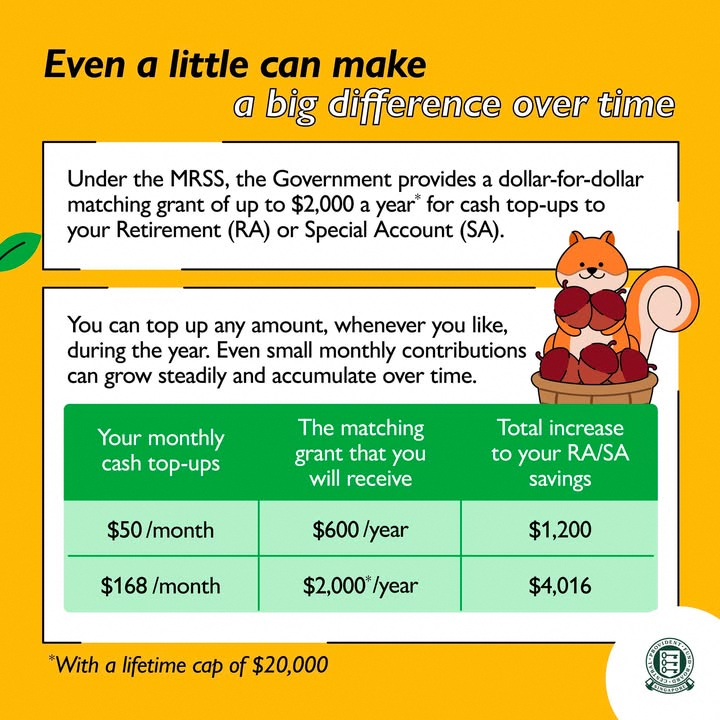
MRSS allows eligible CPF members to receive dollar-for-dollar Government matching grants of up to $2,000 a year, with a lifetime cap of $20,000, when they make or receive cash top-ups to their retirement savings.
Eligible members will be notified by CPF Board and can also check the status via their personalised Retirement Dashboard under the "Matching grant for cash top-ups" section.

Now that you're a few years into retirement, consider whether your current home still serves you the way it did before.
Your household needs may have changed, and a smaller, more manageable space may lower household expenses and free up proceeds for your retirement.
What happens when you sell a property at age 55 and above
When you sell a property at age 55 or above, you must refund the principal amount withdrawn from your CPF savings for the property, together with the accrued interest you would have earned had the savings remained in your OA.
The refund will first be used to top up your RA to your Full Retirement Sum. Any balance will remain in your OA, where you can leave it to earn interest, use it towards your next home or withdraw it in cash.
Rightsizing your home
A smaller home helps free up cash from the sale, lowers your monthly utility and maintenance costs, and can be tailored to suit your needs as you age.
Check out the homes you can consider if you’re looking to rightsize your home!
Selling part of your lease with the Lease Buyback Scheme
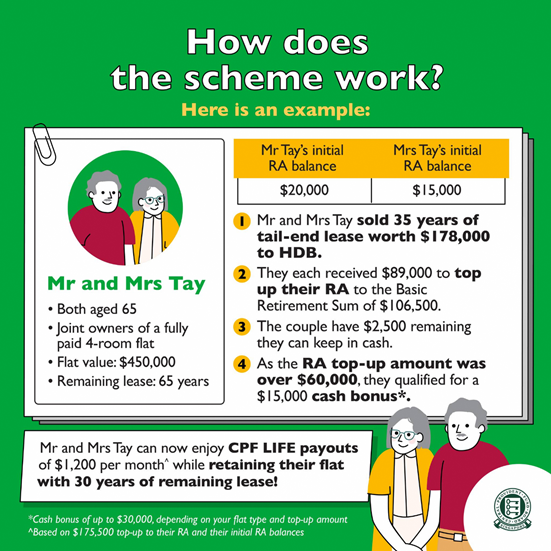
If you’re looking to monetise your flat while continuing to live in it, the Lease Buyback Scheme lets you sell part of your flat’s lease to HDB and choose to retain the length of lease based on the age of the youngest owner.
The proceeds from selling part of your flat’s lease will be used to top up your CPF Retirement Account (RA). Your CPF RA savings can then support your CPF LIFE payouts, giving you monthly income for life. There is also a cash bonus of up to $30,000 depending on your flat size, with the full bonus paid once the combined total RA top-up reaches $60,000.
Use the Home Purchase Planner for your next property purchase
The Home Purchase Planner takes into account your current financial and housing situation, housing grants and desired financing option to provide a personalised home-purchase budget.
You can also use it to see how your CPF usage for monthly instalments could affect your retirement payouts.

Healthcare costs tend to rise as you age, just as your income may fall after retirement. This makes it a good time to check that your healthcare coverage still fits your needs and your budget.
What can MediSave be used for?
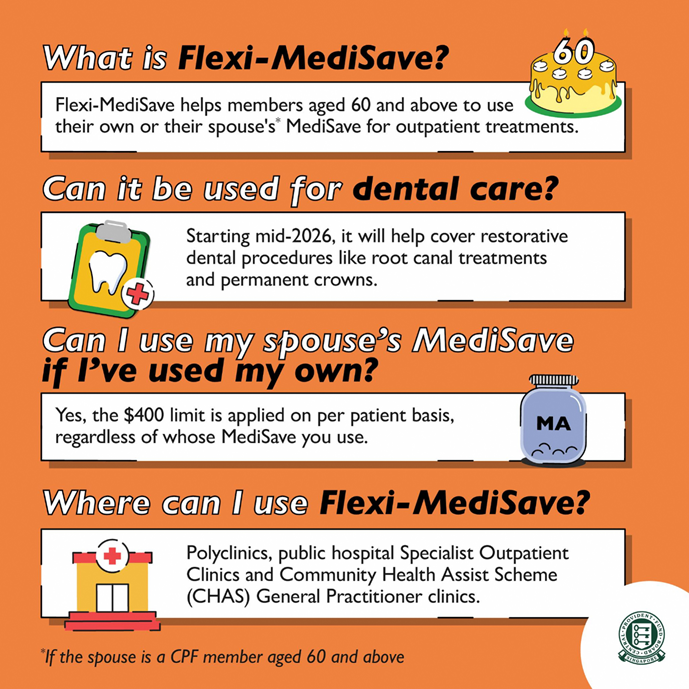
Your MediSave Account (MA) can be used for a wide range of healthcare needs such as hospitalisation, day surgery, selected costly outpatient treatments like dialysis or cancer drugs, and long-term or palliative care.
It can also pay for your MediShield Life and CareShield Life premiums in full, and your Integrated Shield Plan premiums up to a set limit each year.
A cap to your MA balance: Basic Healthcare Sum (BHS)
Your MA has a cap, which is known as the BHS. Once you turn age 65, your BHS is fixed for life at the prevailing amount that was in the year you turned 65.
Any MediSave contributions beyond the BHS will instead flow into your RA, adding to your monthly payouts.
Should I keep my Integrated Shield Plan (IP)?
If you hold an IP, it's worth knowing that MediSave can only cover its private insurance component up to an annual Additional Withdrawal Limit.
Any premium above that limit must be paid in cash, and private insurance premiums can run up to five times higher in your 70s and 80s than in your 40s.
Before renewing your IP each year, consider whether you are likely to use its higher ward class or private hospital coverage, and whether you can comfortably sustain the premiums on your retirement income.
Knowing the difference between ElderShield and CareShield Life
Some older Singaporeans may still be on ElderShield instead of CareShield Life. ElderShield pays a monthly cash payout of up to $400 for five to six years if you're unable to perform at least three of six daily activities independently.
You can consider opting in to CareShield Life, which pays a higher monthly amount for as long as you remain unable to perform these activities. More importantly, the payouts have no fixed end date and come with government premium subsidies for lower-to-middle-income households. Note that there might be an additional “catch-up” component that you will have to pay on top of your base premium if you are converting.
Check which scheme you're on through the Healthcare dashboard on the CPF website.
Matching grants with the Matched MediSave Scheme (MMSS)
MMSS provides dollar-for-dollar cash top-ups to your MA, up to $1,000 a year, for Singapore Citizens aged 55 to 70 with lower MA balances and income. Unlike MRSS, MMSS eligibility stops at age 70, so consider making use of it while you still qualify.
Check your eligibility through the Healthcare dashboard. The matching grant is credited automatically the following year, with no application needed.
It is equally important to make arrangements for how they will be managed if you are no longer able to do so. Taking action early can make things much easier for your loved ones when the time comes.
CPF Nomination
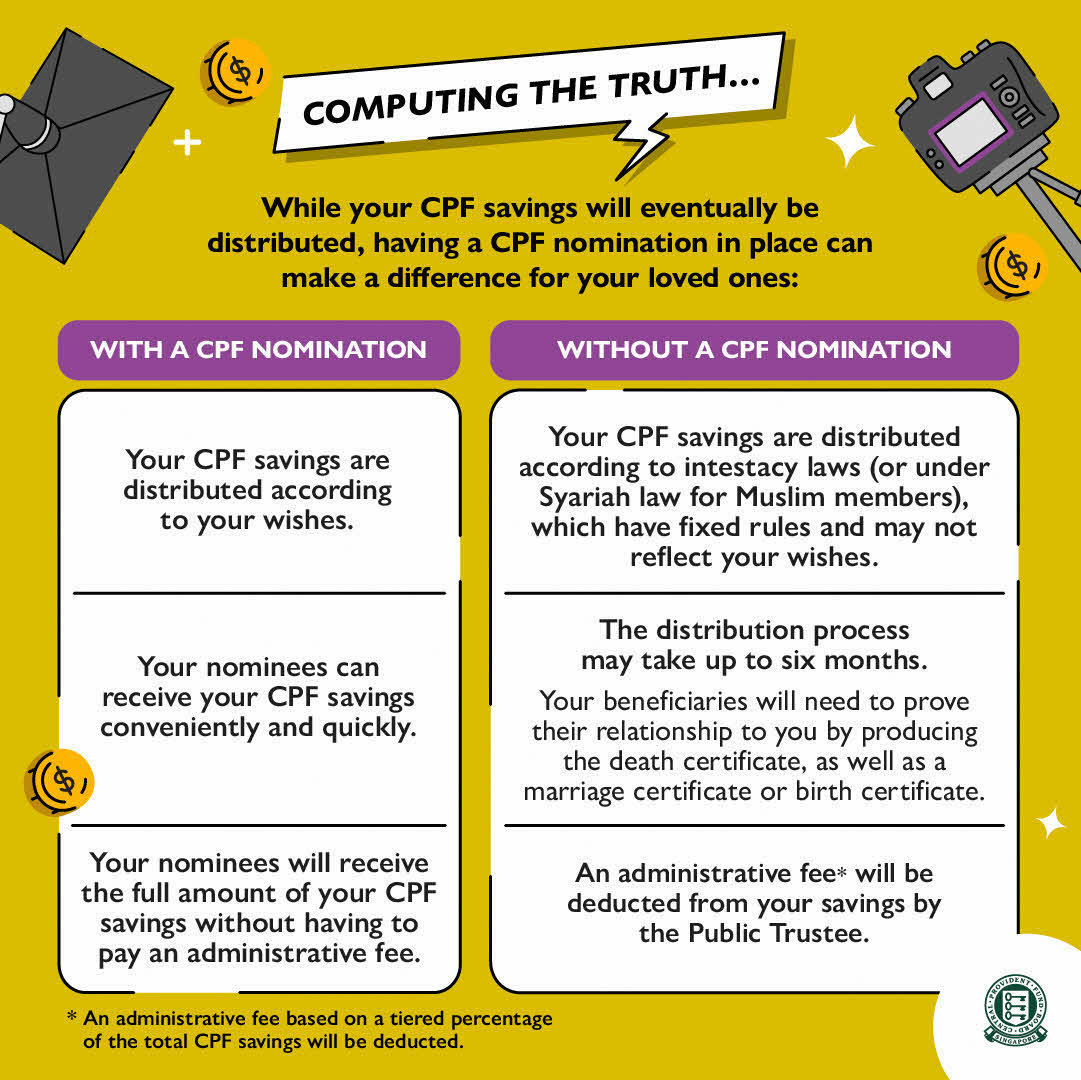
A CPF nomination lets you specify who receives your CPF savings when you pass away. This allows your nominees to receive them quickly without going through the Public Trustee's Office.
Without one, your savings are distributed under intestacy or Muslim inheritance laws which might not account for your unique family circumstances.
Lasting Power of Attorney (LPA)
An LPA covers what happens while you're still alive but no longer able to make decisions for yourself. It's a legal document that lets you appoint trusted individuals, known as Donees, to decide on your behalf if you lose mental capacity, over your personal welfare, property and financial affairs, or both.
A useful example of when an LPA matters is when an individual’s mental clarity fades from dementia, a stroke, or a similar diagnosis. Without an LPA, family members, including a spouse or child, do not automatically have the legal authority to make decisions on your behalf, such as accessing bank accounts to pay for care costs or consenting to medical treatment. They may need to apply to court for a deputy to be appointed, depending on the decisions required.
You can apply online, have your Donees accept online, then visit a Certificate Issuer (an accredited doctor, lawyer, or psychiatrist) for certification. An LPA can only be made while you still have full mental capacity, so it's worth doing while you're able to.
Advance Care Plan (ACP)
An ACP gives your loved ones clear instructions on your healthcare wishes when you can no longer speak for yourself. This can include medical treatments and care arrangements. This ultimately helps to ease the burden of decision-making and provide peace of mind for both you and your family.
To create an ACP, start by reflecting on the quality of life you want and the medical treatment you are comfortable with. Then, discuss them with your loved ones so they understand your wishes and can help ensure they are respected if the need arises.
You can also document your ACP on the myACP online service where it will be registered in the National Electronic Health Records (NEHR) upon completing all discussions with your facilitator.

Retirees are a common target for scams, which have grown more sophisticated in recent years. Here are a few measures you can take to safeguard your CPF savings.
Trusted Contact notification service
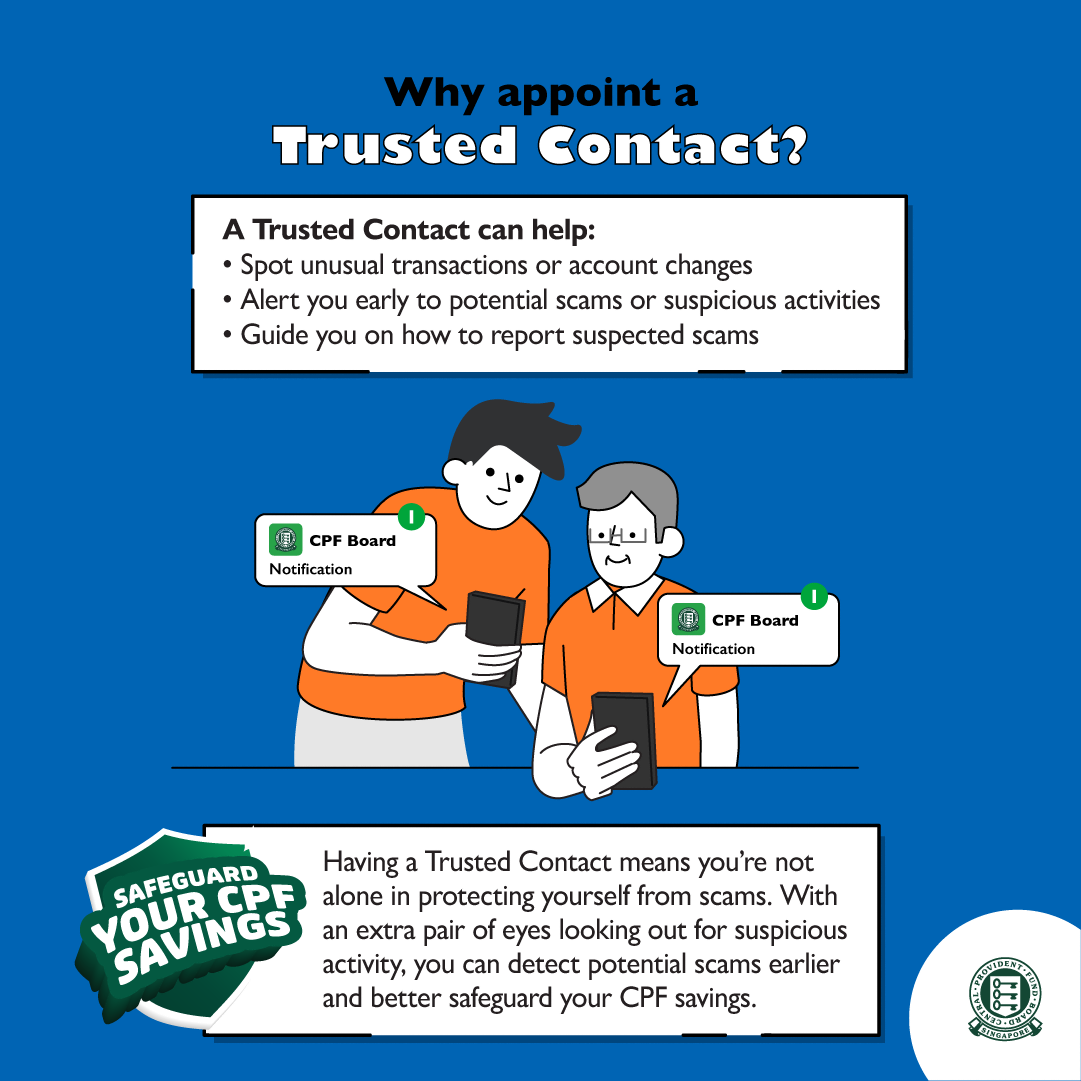
This service lets you appoint up to two trusted loved ones to receive copies of your CPF notifications for four transactions: lump sum withdrawals, bank account updates, daily withdrawal limit changes, and contact detail updates.
This helps to provide an extra pair of eyes on your CPF savings. Take note that a Trusted Contact cannot view your balance or make any CPF transactions.
CPF Withdrawal Lock
Activating the CPF Withdrawal Lock allows you to block online CPF withdrawals. You can set your Daily Withdrawal Limit to $0, so scammers will not be able to make online withdrawals if your CPF account is compromised.
Raising the limit takes 12 hours and also requires extra authentication. Alternatively, you can also withdraw in person at a CPF Service Centre.

While savings are important, your health plays a big part in how well you can enjoy retirement. A few simple healthy habits can help you stay active and independent for longer.
Maintaining a healthy, active lifestyle, and eating well
Eating healthily doesn't need to be expensive. Cooking at home is usually the healthiest option, and simple changes like substituting herbs and spices for salt can go a long way. When eating out, asking for extra vegetables can help you hit the recommended two servings a day.
Staying active doesn't require an expensive private gym membership either. Light walks in the park are a good start, and a free ActiveSG membership gives $100 in credits for pools, gyms, sports facilities, and even ActiveHealth programmes to combat age-related loss of muscles . Bodyweight exercises like squats work just as well at home, with no equipment needed.
Managing your health with Healthier SG
Enrolling with a family doctor clinic under Healthier SG is also a useful way to keep track of your health.
Your clinic works with you on a personalised health plan, which covers everything from lifestyle habits to chronic disease management. Fees are fully subsidised for your first consultation and annual visits.
Retiring well with CPF

The CPF decisions you've made over the years have laid the foundation for your retirement. The focus now is to live well and keep key matters such as CPF LIFE, healthcare coverage, future housing arrangements, and CPF nomination up to date, so you can enjoy this new phase of life with greater peace of mind.
If you found this guide useful, be sure to bookmark and revisit it whenever you need it. Happy retirement!
Information in this article is accurate as at the date of publication.

_600x400.webp/jcr:content/renditions/cq5dam.thumbnail.300.200.webp)

