27 Jul 2026
SOURCE: CPF Board

Picture a post-retirement Tuesday morning. No alarm. You wake up at your own pace, sip on your favourite morning beverage, and have the freedom to decide what the day holds. Maybe it's just going for a leisurely stroll in the park or a long lunch with an old friend.
Whatever it looks like for you, the one thing making it possible in retirement is a reliable source of income.
For most Singaporeans, that income starts with CPF LIFE. And for many, the question is how much they will eventually receive in lifelong monthly payouts.
Depending on the duration before you retire, the difference between a basic and a comfortable payout comes down to decisions you make today.
With possibly decades before your retirement, there’s no harm in crunching the numbers now to make that Tuesday morning less of a dream and more of a plan.
What do you want your retirement to look like?
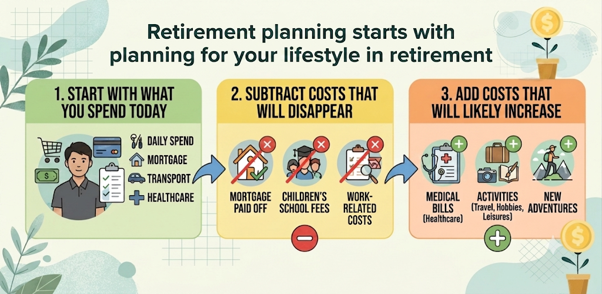
Image created with AI assistance
Before you plan how much to retire with, figure out how much you will need in retirement. Most skip this step and land on a vague figure because retirement often feels like an abstract concept when they are still working.
But the lifestyle you want in retirement has a dollar figure attached to it, and working backwards from that number is the clearest way to know whether you are on track.
A practical way to estimate this is to start with what you spend today. Subtract expenses you may not incur in retirement, such as your mortgage once it is paid off, or work-related costs like commuting and meals bought during the workday.
Next, add the costs that will likely increase, such as medical bills and activities that fill the time you used to spend working.
Don’t forget to factor in inflation too. The cost of living rises steadily over time, and the amount you need at 65 will be higher than what the same lifestyle costs today.
To give yourself a practical starting point today, here are three broad lifestyle tiers to consider.
Around $1,000 a month
This amount would likely cover your essentials. A typical month might look like this: home-cooked meals most days, with simple hawker fare whenever you eat out. You get around on public transport, catch up with friends over local coffee, and spend your free time on morning strolls or drop-in classes at the community centre.
There is little room for holidays or big-ticket spending, but your core needs are met.
Around $2,000 to $3,000 a month

This amount may allow more options in your spending. A typical month might include a few meals at a casual restaurant or a café, while also enjoying a massage or two for some self-care.
Once or twice a year, you may take a short regional trip, perhaps a long weekend in Penang or a few days in Bangkok. With this amount, you could still have a buffer for cosy family gatherings, and the occasional gift for your loved ones.
A financially-sound retirement may sound enticing, but it also means putting in the effort to save consistently during your working years to make it a reality. A typical month might include regular restaurant dinners, a gym membership or fitness classes, and greater flexibility to enjoy the activities and experiences you value.
You may also have more room in your budget to maintain your desired private healthcare insurance coverage. You travel a few times a year, including the occasional longer trip to Europe or Japan.
What you need in your Retirement Account (RA) to receive $3,000 a month in CPF LIFE payouts

Your CPF savings may not be your only source of retirement income. But because CPF LIFE provides payouts for life, it's worth checking whether your CPF savings are enough to cover the monthly payout you're aiming for.
The CPF Retirement Sum serves as a reference point for how much you need to save to meet your desired monthly payouts. Once you reach age 55, your retirement sum is fixed and will not increase.
However, if you are below age 55, the retirement sum that applies to you will be adjusted each year due to inflation, longer life expectancy, and improvements in standards of living. This means that the retirement sum that applies to you will be higher than the current retirement sum.
Here’s a look at the retirement sums and expected monthly payouts for those who turn 55 this year:
*Factoring in CPF interest rates of up to 6% per annum to grow your RA savings through compound interest.
1 Payout figures are based on a male member on the CPF LIFE Standard Plan and may also be adjusted to account for long-term changes in interest rates or life expectancy. Such adjustments, if any, are expected to be small and gradual.
Looking at the table above, if you are a male member on the CPF LIFE Standard Plan, you will need $440,800 in your Retirement Account (RA) at age 55 to receive $3,440 a month in lifelong monthly payouts from age 65.
How to increase your monthly payouts from CPF LIFE

Your CPF savings earn risk-free interest of up to 6% per annum and grow further thanks to the power of compound interest. The earlier you contribute, the more time your savings have to compound and grow your retirement savings.
Give your retirement savings a boost by making a cash top-up directly to your SA (if you are below age 55) or RA (if you are age 55 and above). While a one-off top-up works, consider setting up small, regular top-ups through GIRO instead.
If you have OA savings that you might not need for housing, transferring them to your SA is worth considering as they earn a higher interest rate. The OA currently earns 2.5% per annum, compared to 4% per annum for the SA.
Keep in mind that this transfer is one-directional. Once your money is in the SA, you cannot move it back to the OA.
To earn the higher interest rate of up to 6% per annum in your RA, you can set up a standing instruction to make automatic monthly transfers from your OA.
A standing instruction takes the hassle out of manual top-ups, automatically placing fresh OA funds from your monthly CPF contributions into your RA to effortlessly boost your retirement savings and future monthly payouts.
If you plan to work past age 65 or simply do not need the money yet, deferring your payouts helps to increase them.
Your payouts increase by up to 7% for each year you defer, which works out to an increase of up to 35% if you defer all the way to age 70. Your CPF payouts will automatically start at age 70, if you had not requested CPF Board to start your CPF payouts between the ages of 65-69.
Use the Retirement Payout Planner to plan for your retirement
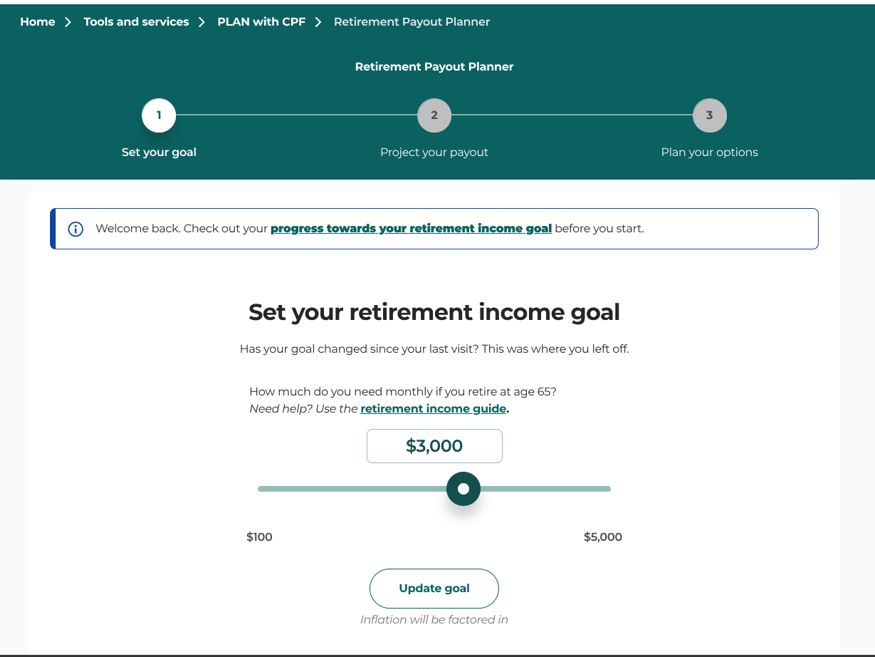
The CPF Retirement Payout Planner lets you set a retirement payout goal based on your desired retirement lifestyle and helps forecast whether your current income can help you reach this goal.
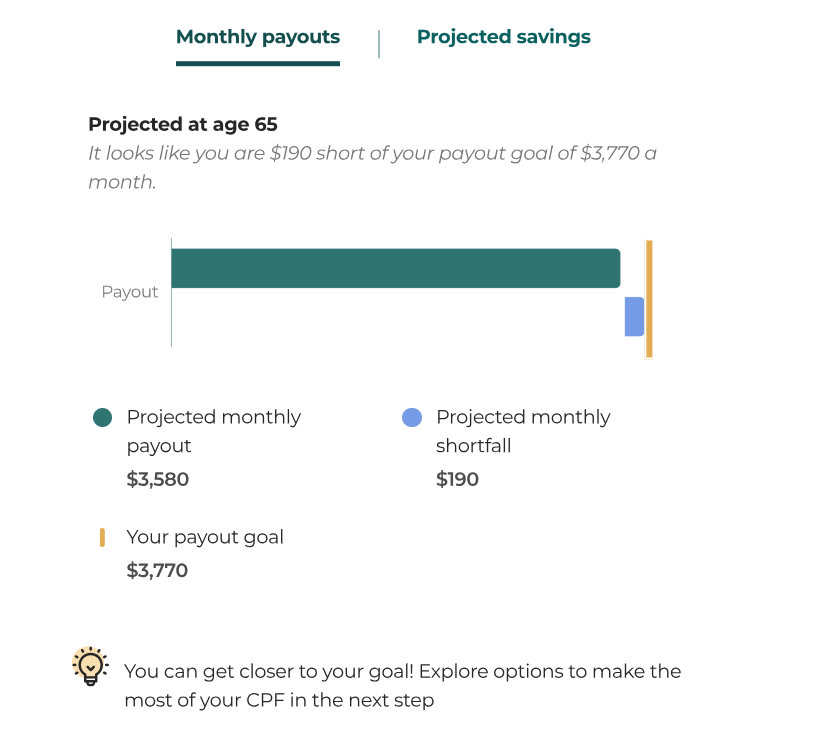
This tool can be completed in minutes and also lets you simulate actions such as top-ups to your CPF savings, so you can see how they can bring you closer to your retirement payout goal.
Meet your retirement goals with CPF LIFE
Retirement planning might feel distant when you are decades away from it, but it becomes achievable if you start today and bank on the power of compound interest and consistent contributions to reach your goal.
To get started, check out the Retirement Payout Planner. It shows exactly how far you are from your goal and what you can do to close the gap. Whether your goal is $1,000, $2,000 or $3,000 a month, the planner provides a personalised path to help make it a reality.
Information in this article is accurate as at the date of publication.