2 Sep 2026
SOURCE: CPF Board

When it comes to retirement planning, ensuring that you have enough money to comfortably cover your living expenses is often top of mind. After all, if you stop working, a concern might be that you may no longer have a steady income stream from work to enjoy your golden years.
A key place to start your planning is with your CPF savings. You might have heard of different retirement sum tiers and yearly adjustments to your CPF monthly payouts – how does that affect your retirement planning, and would you need to save more outside of CPF?
Here’s what you need to know about the CPF Retirement Sum and how it shapes your monthly payouts!
What are the three levels of the CPF Retirement Sum?
- The Basic Retirement Sum (BRS) provides monthly retirement payouts for your basic living needs, excluding rental expenses.
- The Full Retirement Sum (FRS) is double the BRS and is the default amount to save for your retirement needs.
- The Enhanced Retirement Sum (ERS) is double the FRS and provides higher monthly payouts. This is the maximum limit you can top up to.
Regardless of which sum you prefer, the retirement sum is meant to be a reference point on how much to set aside for your desired retirement payouts, and is not a mandatory amount that you must save.
So, which sum is right for you? People tend to miss out on this little-known fact – it actually depends on how much you need each month in retirement, rather than choosing one lump sum from the start. Knowing your monthly amount makes it easier to decide which retirement sum to work towards.
Watch this short video to learn more about the retirement sums!
Why do the retirement sums increase each year?
Once you turn 55, your BRS and FRS are determined based on the amounts for that year and will not be affected by future changes. For example, if you turned 55 in 2026, the BRS and FRS will remain unchanged at $110,200 and $220,400 respectively, even as these two sums increase for future cohorts.
However, you may notice that the BRS, FRS, and ERS amounts have steadily increased over the years for future cohorts. This is because the retirement sums are adjusted yearly to account for these factors:
1. Rising cost of living
As prices increase and goods and services become more expensive over time, more savings are needed to cover future expenses.
2. Increasing life expectancy
The life expectancy at age 65 was 21.6 years in 2025, a 0.2 increase from 2024. This means that those who are 65 this year can expect to live to about 86 years old. As people live longer, more savings are needed to last throughout retirement.
3. Improving standard of living
With higher incomes and standards of living, spending and retirement lifestyle expectations naturally increase. Setting aside more savings can provide higher retirement payouts to support your expenses in retirement.
Your desired monthly payout helps guide which retirement sum you can set aside
How much you want to receive each month in retirement is the starting point for your CPF planning. Simply put, the more you have set aside in your RA, the higher your monthly payouts will be.
While the BRS and FRS amounts are fixed based on the year you turn 55, the ERS increases yearly. For example, if you turned 55 in 2026, the BRS and FRS will remain unchanged at $110,200 and $220,400 respectively, even as these two sums increase for future cohorts. For the ERS, the amount for 2026 is $440,800, which will later increase to $456,400 for 2027.
Here’s a quick overview of the retirement sums in 2026 and the estimated monthly payout:
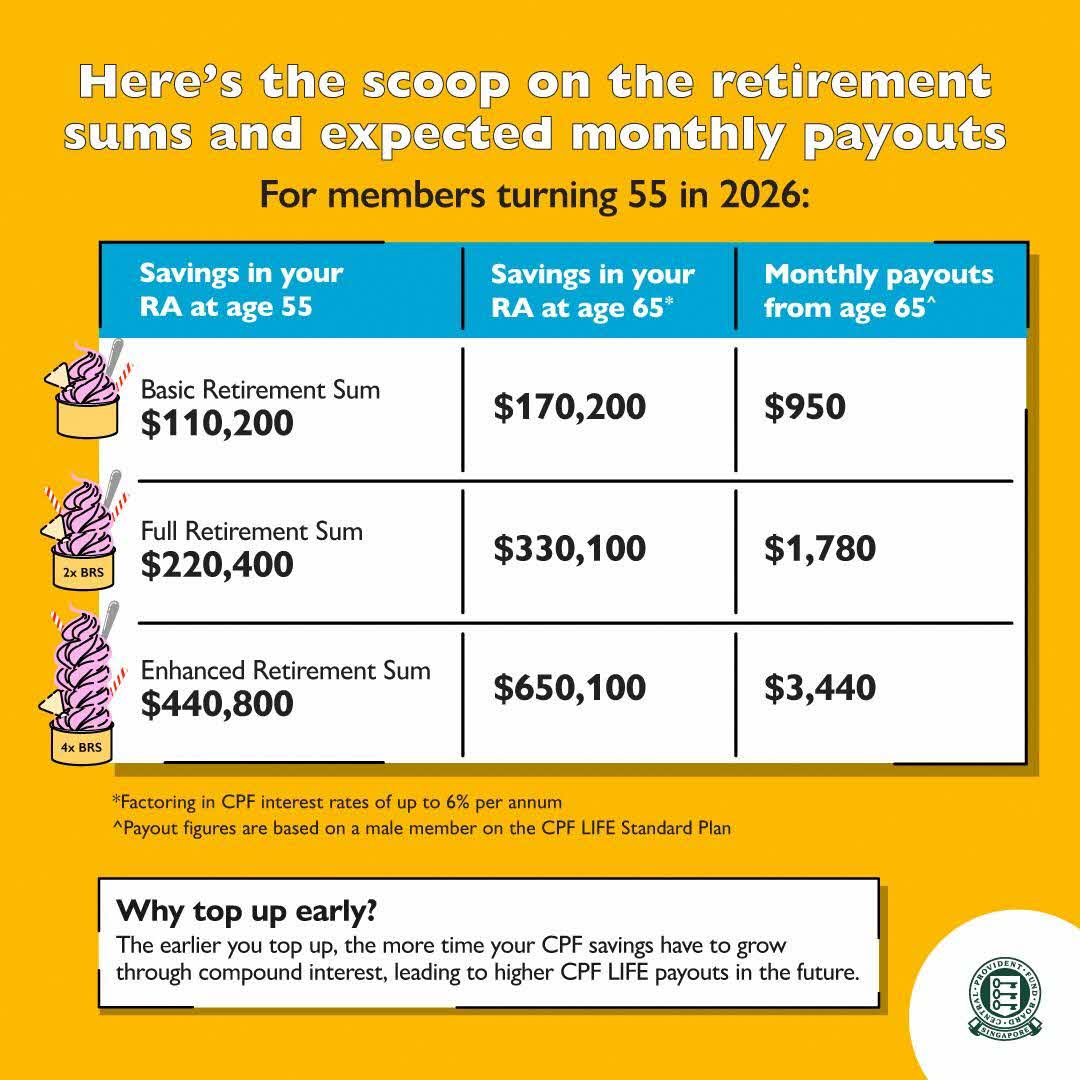
As shown above, setting aside the retirement sum gives you a guaranteed monthly income in your golden years for as long as you live. At age 55, if you think you need:
- An estimated monthly payout of $950 from age 65: you can set aside the BRS of $110,200 which will grow to $170,200 by age 65.
- An estimated monthly payout of $1,780 from age 65: you can set aside the FRS of $220,400 which will grow to $330,100 by age 65.
- An estimated monthly payout of $3,440 from age 65: you can set aside the ERS of $440,800 which will grow to $650,100 by age 65.
These figures are calculated using an interest rate of 6% per annum and based on a male member on the CPF LIFE Standard Plan.
You are not required to top up to your BRS, FRS, or ERS, however, having lower savings in your RA means receiving lower monthly payouts in retirement. For higher payouts, you can consider topping up to the current ERS when you turn 55 years old.
What you can do to receive higher retirement payouts
If you are looking to boost your monthly retirement payouts, here are three simple ways to do so:
1. Make voluntary top-ups and transfers to your Retirement Account (RA)
If you are aged 55 and above, you can top up your RA up to the current ERS of $440,800 to maximise your monthly payouts.
By topping up your RA steadily as you continue working, your savings can start earning higher interest earlier, helping to boost your CPF LIFE payouts in retirement.
If you are still working after age 55 and do not require your OA savings for other needs, you can also consider growing your retirement payouts by making regular transfers from your Ordinary Account (OA) to your Retirement Account (RA) through our standing instruction service. This lets you transfer your monthly CPF contributions from your OA into your RA on a regular basis, without having to make manual transfers each time.
Remember, the earlier you top up or transfer, the more your savings can benefit from the power of compound interest. For example, if you top up in January instead of December, you can earn up to 20% more interest in just 10 years!
2. Defer your CPF LIFE payouts
While you can start receiving CPF LIFE payouts as early as age 65, you can also choose to defer them up to age 70. For each year that you defer, your monthly payouts increase by up to 7%. This means waiting until age 70 gives your payouts a boost of up to 35%!
If you’re still working or have other sources of income and do not need funds immediately, deferring is a practical option to secure a higher monthly payout later.
3. Apply for a Voluntary Housing Refund (VHR)
If you previously used your OA savings to buy your home, consider making a Voluntary Housing Refund (VHR) to boost your retirement nest egg. The amount refunded will be put into your RA (if you are aged 55 and above) to meet your FRS. This way, your savings can also grow steadily and earn risk-free interest, allowing you to receive higher monthly payouts in retirement.
Additionally, if you plan to sell and rightsize your home, making a VHR early can help you keep more cash proceeds from the property sale by reducing accrued interest, so you don’t have to eat into your retirement savings.
Do note that these are all voluntary actions, and you should consider your current situation and financial needs before you take action.
Start building your ideal retirement
Planning early gives you control and peace of mind knowing that you will have a steady and guaranteed monthly income in retirement, so you never have to worry about outliving your savings.
You can view your Retirement dashboard to find out whether you have set aside your FRS and check how much you can top up for higher monthly payouts.
Go further in your retirement planning and try out the Retirement Payout Planner to see your projected monthly payouts, set a retirement income goal, and simulate actions like cash top-ups to help you reach it.
Information in this article is accurate as at the date of publication.


_600x400.webp/jcr:content/renditions/cq5dam.thumbnail.300.200.webp)
_600x400.webp/jcr:content/renditions/cq5dam.thumbnail.300.200.webp)