7 May 2026
SOURCE: CPF Board

If you leave your money idle, its value will gradually erode overtime due to inflation.
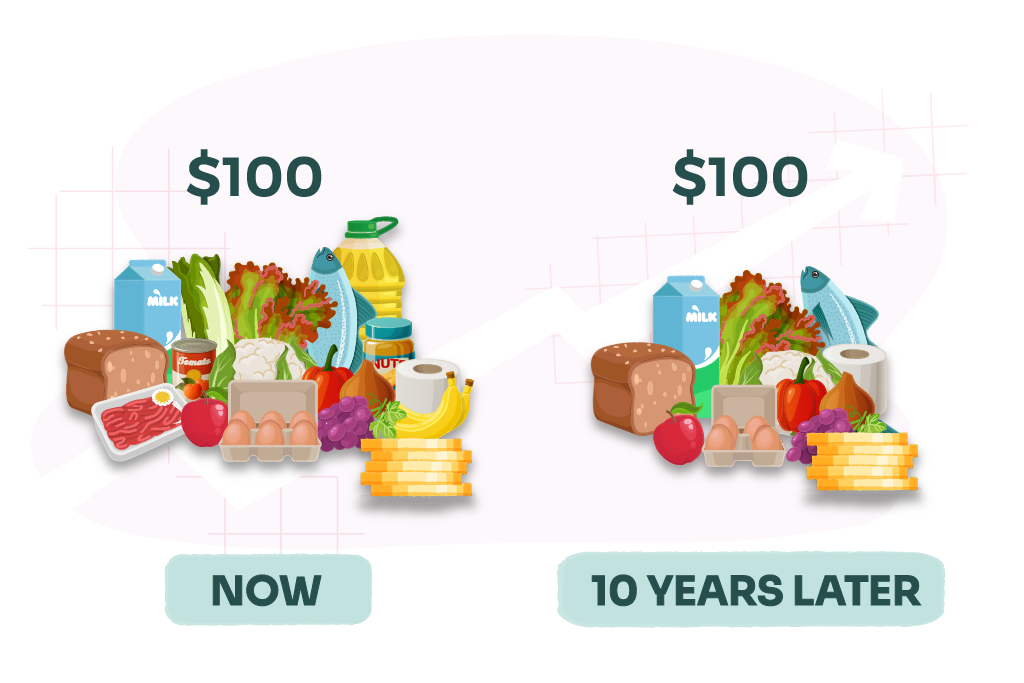
Consider this: spending $100 at the supermarket will get you fewer groceries a decade from now. What you need for your retirement today might not be the same in the future. That’s why it’s important to grow your money and make it work harder for you.
Investing is one of the most effective ways to grow your savings over time, especially since retirement may still be years away. The earlier you start, the more time your money has to grow.
At its core, investing involves purchasing assets with the expectation that their value will increase or generate income over time. These assets can range from financial instruments like stocks and bonds to tangible items such as real estate.
While the likes of trading cards, art, wine, and luxury watches have gained popularity as alternative investment options, this article will cover the more common investments that are easily accessible to most individuals.
Before we get started with investments, it’s essential to keep several investment fundamentals in mind. These apply to all types of investments, so keep them handy when reviewing any investment opportunity.
Just like the age-old saying about not putting all your eggs in one basket, diversifying helps to protect your investments.
It’s important to understand the relationship between different investment products to diversify successfully. Assets that increase or decrease in value in tandem are considered correlated. For instance, stocks across different sectors generally decline in price during market downturns.
To diversify your investment portfolio, consider including stable assets that are not heavily influenced by market trends. One such example are bonds that offer steady returns and can help balance out the volatility of other investments.
All investments come with risks. Before you invest, understand that there is a real possibility that you might lose some or all your investment outlay.
A handy rule to follow is to only invest money that you can afford to lose. This is because there is always a risk that your investments can decrease in value.
Investing for retirement is a common strategy to grow savings, as the long runway of around 20 or 30 years will allow investments to better ride out market volatility and reap returns.
If an investment promises high returns within a short period, it is likely that there’s an equally high chance of losing your original investment.
How long you plan to invest (which is your investment horizon) should guide the decisions you make. A longer investment horizon (such as 10 years or more) allows you to ride out short-term market volatility and recover from temporary dips in value. The appropriate horizon will differ from person to person, depending on factors such as age, income, risk tolerance, and financial goals.
For short-term goals like saving for a holiday, it is better to keep that money in a safe and easily accessible bank savings account instead. Investing it would expose you to unnecessary risk, particularly if you need the funds within a year or two.
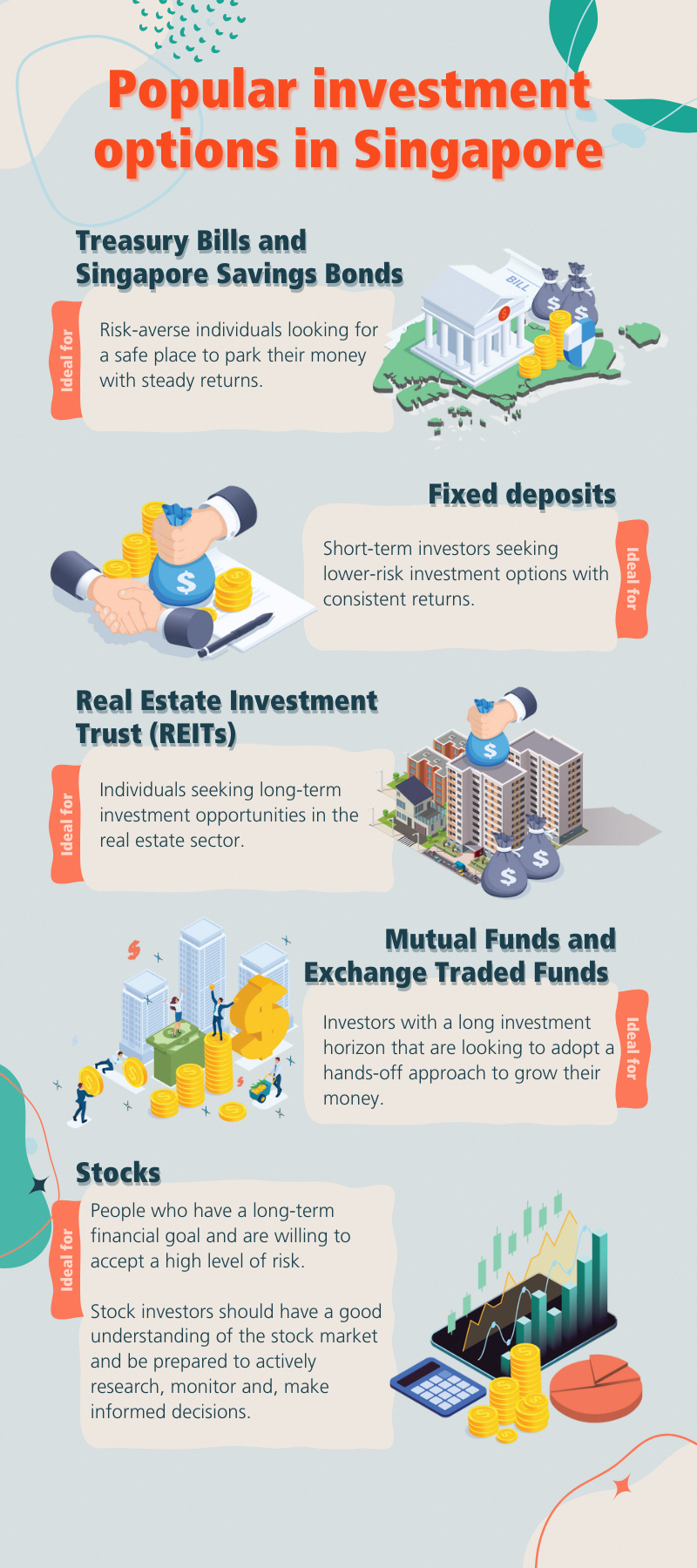
From bonds that guarantee steady returns to riskier investing alternatives such as stocks, here are some popular investment options to get started on your investment journey.
The CPF Board does not endorse any investment providers or products.
Treasury bills (T-bills) and Singapore Savings Bonds (SSBs) are lower-risk investment products issued by the Singapore Government.
T-bills are sold at a discount to their face value. When they reach their maturity date, which can be in either 6 months or 1 year, you can sell them at their full-face value.
Compared to T-bills that only have a 6-month or 1-year investment horizon, SSBs allow you to hold your investment for up to 10 years and redeem the principal amount and any accrued interest monthly with no penalty.
T-bills and SSBs are guaranteed by the Singapore Government and carry a AAA credit rating (the highest level possible). This makes them among the safest investment options available.
Ideal for: Risk-averse individuals looking for a safe place to park their money and generate steady returns.
Fixed deposits, also known as term deposits or time deposits, are a type of deposit where a specific sum of money is placed with a bank or financial institution for a predetermined period.
The institution guarantees a fixed interest rate on the deposit for a specified duration. At the end of the term, you receive both the original deposit amount and the interest earned. There are conditions or penalties if you withdraw your deposits before the maturity date, so make sure to cater sufficient funds for your other daily expenses.
Fixed deposits are considered lower-risk investments as they are guaranteed by banks or financial institutions. There is a possibility that you may not receive your deposit if these institutions become insolvent but note that all bank deposits in Singapore are insured up to $100,000 by the Singapore Deposit Insurance Corporation (SDIC).
Ideal for: Short-term investors seeking lower-risk options with steady returns.

Mutual funds and Exchange Traded Funds (ETFs) are professionally managed investment products that provide diversification across a mix of asset classes.
Mutual funds and ETFs can offer higher returns compared to fixed deposits or bonds, but they also carry greater risks. As these products are analysed and managed by a fund manager, they also come with management fees that can reduce your overall returns.
With higher-risk investments, there is a genuine possibility of experiencing losses. Your returns are not guaranteed. Therefore, it is important to thoroughly understand the product and its associated risks before committing your hard-earned money.
Ideal for: Investors with a long investment horizon who are looking to grow their money at a higher rate as compared to fixed deposits and bonds.
Mutual funds are also well-suited for those who prefer a hands-off approach to investing, as a professional firm manages the investments on their behalf.
Gold has been traded for thousands of years and has seen a surge in popularity in recent years, driven by its sharp rise in price.
Gold can be invested in Singapore by buying physical gold bars or coins, trading gold ETFs, or investing through gold mutual funds or unit trusts.
Unlike stocks and bonds, whose prices are largely determined by the performance of a company or government, the price of gold is shaped by economic conditions such as periods of financial uncertainty or geopolitical stress.
Traditionally, gold is held by investors looking to diversify their portfolios and as a hedge against inflation. While it is widely regarded as a safe-haven asset, it is not entirely risk-free. Gold prices can fall sharply and remain that way for extended periods.
Ideal for: Investors looking to add a diversification element to their portfolio.
Investment Linked Insurance Policies (ILPs) combine both insurance and investments. Think of it as a "two-in-one" product that blends life insurance coverage with the opportunity to invest in a range of professionally managed investment-linked funds.
Here are some important pointers to determine if ILPs are suitable for you:
Additional cost
ILPs allocate a portion of your insurance premium to an investment fund. Such funds are managed by third-party fund managers, which may entail higher fees. ILPs also incur additional policy and administrative fees, resulting in higher overall costs as compared to directly purchasing the investment fund.
Increasing insurance coverage costs
The remaining portion of your premium in an ILP is used to provide insurance coverage. The coverage varies according to the premium amount and can range from life insurance to critical illnesses.
An important consideration is that the cost of insurance coverage increases as you age. This is due to the higher risk of illness and death as you get older. To maintain the same level of coverage without increasing your premium, units from your investment fund may need to be sold. This can reduce the amount of money you receive when your policy matures.
Ideal for: Individuals who value the convenience of combining insurance coverage and investment growth in a single product.
A publicly listed company is divided into many equal parts known as shares. When you buy stocks, you are purchasing shares in a company with the expectation that it will perform well and grow in value. For instance, a share worth $10 today could be worth $20 or more in the future. Some listed companies also pay dividends when they make a profit.
Keep in mind that share prices fluctuate daily due to a variety of factors. This means your original investment amount is not guaranteed and you can even lose all of it if the company folds.
A useful tip is to only invest only in stocks you believe in. Do your research by reading the company’s annual reports to understand its financials and plans. It’s also a good idea to stay updated on market trends.
Just as it is important to diversify your portfolio with a range of assets, it is equally advisable to diversify your information sources by gathering insights from various outlets instead of relying solely on one.
Ideal for: Individuals who have a long-term financial goal and are willing to accept a higher level of risk.
Stock investors should have a good understanding of the stock market and be prepared to actively research, monitor, and make informed decisions.

Regardless of your risk appetite, it is always prudent to anchor your portfolio with a secure component.
Whether you are looking at savings, insurance, or investing, CPF plays an important role in personal financial planning. It grows your savings consistently from the day you start working and serves as the foundation for your retirement.
Beyond helping you save for your basic housing, healthcare, and retirement needs, you can also do more with your CPF by making a cash top-up to your CPF savings or by investing them.
The CPF Investment Scheme (CPFIS) lets you invest your Ordinary Account (OA) and Special Account (SA) savings in a range of approved financial products. If you are willing to take on some risk, this may allow you to achieve potentially higher returns than CPF interest rates and grow your retirement savings further.
However, not all savings in your OA and SA can be used for investments. $20,000 from your OA and $40,000 from your SA have to be kept in your CPF accounts before you can invest. This not only helps ensure that you have enough for your retirement needs but also lets you earn the extra interest on the first $60,000 of your CPF balance.
As announced in Budget 2026, the CPF Board will also introduce a new voluntary life-cycle investment scheme in the first half of 2028, providing members with an additional investment option that would complement CPF’s existing risk-free interest rates and the CPFIS.
Life-cycle investment products are designed to automatically adjust a portfolio’s asset allocation over time as it approaches a specified target date, typically retirement. The CPF Board will work with commercial product providers to offer simplified, low-cost, and diversified life-cycle investment products under the new scheme.
This new scheme caters to long-term investors who are willing to take some risk for potentially higher returns but may have less expertise in navigating the CPFIS offerings or prefer not to actively manage their investments.
Investing allows you to grow your wealth with potentially higher returns and there are plenty of ways to invest according to your risk appetite and preferences.
As with most things in life, the key is to adopt a balanced approach. Happy investing!
Information in this article is accurate as at the date of publication.
_600x400.webp/jcr:content/renditions/cq5dam.thumbnail.300.200.webp)

