9 Mar 2026
SOURCE: CPF Board

As we move forward in a changing world, retiring with confidence and peace of mind is key. Here’s how the CPF changes announced during Budget 2026 will benefit your retirement.
The CPF Board will introduce a new life-cycle investment1 scheme in the first half of 2028, providing members with an additional investment option that would complement the existing CPF’s risk-free interest rates and the CPF Investment Scheme (CPFIS).
The CPF Board will work with commercial product providers to offer simplified, low-cost, and diversified life-cycle investment products under the new scheme.
Participation in the new scheme will be voluntary.
1 Life-cycle investment products are designed to automatically adjust the investor’s portfolio’s asset allocation over time as it approaches a specified target date, typically retirement.
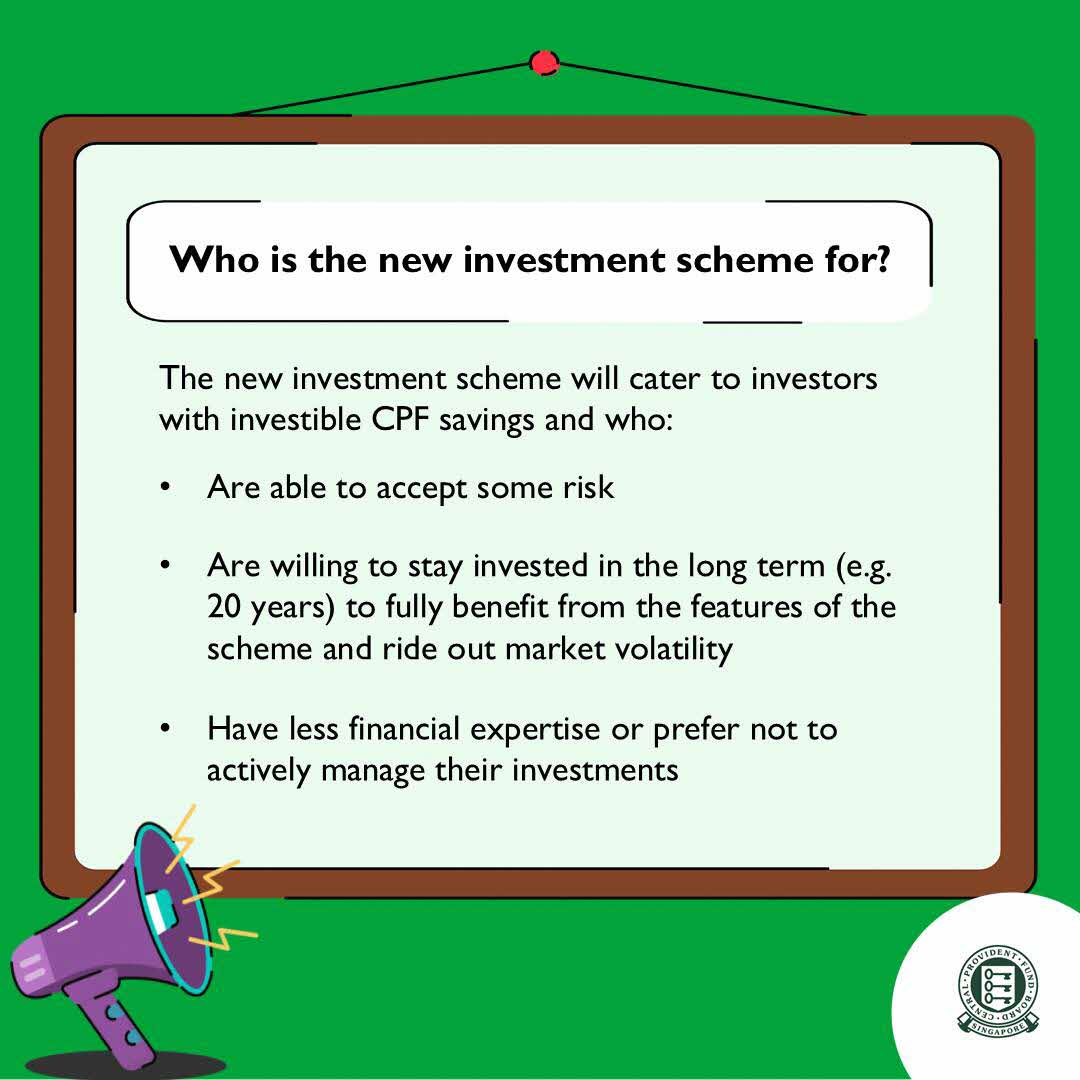
This new investment scheme caters to long-term investors who are willing to take some risk for potentially higher returns, but may have less expertise in navigating the CPFIS offerings or prefer not to actively manage their investments.
While the products under the new scheme will be provided and managed by commercial product providers, the Government is prepared to provide some time-limited support to kickstart the scheme.
As we grow older and edge towards retirement, we might face a change in financial goals, and might want to do more to safeguard our retirement nest egg instead of taking more risks in our investments.
With this new scheme, investors’ portfolio mix will automatically rebalance from higher-risk assets. As the investors age, equities will be rebalanced to lower-risk assets such as bonds before being liquidated in phases by the target date. For example, if the target date is set at 65 years old, your investment portfolio could be liquidated in phases ahead of your 65th birthday.
This calibrates the amount of risk which investors are exposed to at different stages of life and mitigates the risk of exiting an investment portfolio during a market downturn.
Upon phased liquidation, the investment sale proceeds will be transferred to the investor’s Retirement Account (RA), up to the Full Retirement Sum (FRS). Any remaining proceeds will be transferred to the Ordinary Account (OA). The funds in the RA can then be used to join CPF LIFE when the member decides to start their monthly payouts anytime from age 65, boosting their monthly payouts.
To simplify decision-making for investors, two to three reputable product providers will be selected to offer a small number of options.
All-in fees will be capped to minimise costs and allow investors to retain and benefit from more of their investment returns.
Find out more about the new CPF investment scheme.
CPFIS allows you to invest your Ordinary Account (OA) and Special Account (SA) savings in a wider range of financial products such as insurance products, unit trusts, fixed deposits, bonds and shares.
However, this option requires more active investment management, as you’ll need to select from the different products and monitor them regularly. This approach is suitable if you have the time, financial savviness, and resources to manage your own portfolio, plus the ability to absorb potential losses.
The new investment scheme is a simpler, more structured option if you do not have as much time or financial expertise to manage your investments.
|
New investment scheme
|
CPFIS
|
Target investor profile
| Investors who are able and willing to stay invested in the long-term (e.g. 20 years) but may have less financial expertise or prefer not to actively manage their investment | Investors with more financial expertise and time to actively manage their investment |
Nature of products
| Pre-mixed portfolio that follows a glidepath2, with phased liquidation before target date to mitigate risk of exiting during downtown | Wide range of investment products (including insurance products, unit trusts, fixed deposits, bonds and shares) for investors to select and manage their own portfolios |
Number of products
| Two to three product providers with curated options, to simplify decision-making for investors | Wide variety of more than 700 products catering to different preferences and risk appetites |
Fees
| All-in fees capped to allow investors to minimise costs and to retain and benefit from more of their investment return | Generally, higher fee cap than the new investment scheme |
2 The predetermined asset allocation strategy that shows how a fund’s investment mix changes over time, typically becoming more conservative (i.e. lower risk exposure) as it approaches a target date.
To invest, the same eligibility criteria will apply for both schemes.
Do note that all investment products involve risk, and returns are subject to market conditions. In general, having a longer investment horizon allows more time for your investments to potentially grow and weather market volatility. You should take time to understand the options available and consider your risk appetite and overall financial circumstances before investing your CPF savings.
Eligible Singaporeans aged 50 and above in 2026 (i.e. born in 1976 or earlier) will receive a CPF top-up of up to $1,500 in their CPF Retirement Account (RA) or Special Account (SA) in December 2026.
The amount of top-up depends on your CPF retirement savings and Annual Value of your local residential property:
CPF Retirement Savings1 (as at 31 Dec 2025)
| Singaporeans born in 1976 or earlier | |
| Own not more than 1 property | ||
| Annual Value not more than $21,000 | Annual Value more than $21,000 but not exceeding $31,000 | |
| Less than $60,000 | $1,500
|
$500
|
At least $60,000 but
| $1,000
| |
1 Computed based on the sum of Retirement Account and CPF LIFE balances, or the sum of Ordinary Account and Special Account balances if the Retirement Account has not yet been created.
From January 2027, the total CPF contribution rates for employees aged above 55 to 65 will be increased to help them save more for retirement.
For employees earning monthly wages exceeding $750
Employee's age
| 2026 | CPF Contribution Rates from 1 Jan 2027 | ||
Total (% of wage) | Total (% of wage)
| Employer (% of wage)
| Employee (% of wage)
| |
55 and below
| 37
| 37
| 17
| 20
|
| Above 55 to 60 | 34
| 35.5 (+1.5)
| 16.5 (+0.5)
| 19 (+1)
|
| Above 60 to 65 | 25
| 26 (+1)
| 13 (+0.5) | 13 (+0.5)
|
| Above 65 to 70 | 16.5 | 16.5
| 9
| 7.5
|
| Above 70 | 12.5
| 12.5
| 7.5
| 5
|
Note: Figures in brackets () denote increase in rates
To better support patients with the recurring costs of conditions under the Chronic Disease Management Programme (CDMP), MediSave withdrawal limits will be increased from $500 to S$700 a year. Those with more complex chronic conditions will be able to withdraw up to S$1000 a year, up from the current $700 limit. These enhancements will provide better coverage for outpatient treatment, vaccinations, and preventive tests for conditions such as hypertension and stroke.
To reflect these changes, the MediSave 500/700 scheme will be renamed to the MediSave Chronic and Prevent Care scheme.
Stay tuned for the latest CPF updates!
Information in this article is accurate as at the date of publication.


