23 Oct 2026
SOURCE: Chuin Ting Weber & Ernest Tham from MoneyOwl

“Why keep your money in your CPF accounts at age 55 when you can get an ILP? The ILP pays a higher dividend of around 7% per year from day one and leaves your family a death benefit of at least 101% of what you invested. Surely this beats out CPF LIFE.”
Agents often make this pitch to CPF members in their 50s. While it sounds like an easy decision to make, it can also backfire badly.
Here’s what you need to know before investing in an ILP when you’re approaching retirement.
What is an ILP?
An investment-linked policy (ILP) combines life insurance coverage with investment.
Your premiums are used to purchase units in one or more unit trusts, known as “sub-funds”. Some units are sold to pay insurance and other charges, while the rest remain invested. Your account value rises or falls with the performance of the sub-funds.
Most ILPs nowadays are structured as “101 ILPs”. Upon death or total and permanent disability, they pay the value of your units or, at a minimum, 101% of your premium as a benefit. This 101% death benefit has sometimes been sold as “capital guaranteed” — a mischaracterisation which is not allowed by the Monetary Authority of Singapore (MAS).
The risks of running short of a stable retirement income
When you withdraw your CPF savings and invest them into an ILP, you no longer depend on a government-backed annuity to deliver income.
Instead, you rely on investment assets to do so. This creates multiple new risks to your retirement income.
Risk #1: Your income decreases if your investment loses value
CPF savings are invested in Special Singapore Government Securities (SSGS). They receive reliable and effectively risk-free returns.
An ILP sub-fund, however, invests in securities – stocks, bonds and other assets. These underlying investments are subject to risk of loss, such as when companies do poorly or even default.
When your sub-fund loses value, your income will also decline. A 7% dividend on $100,000 is very different from a 7% dividend on $50,000.
Risk #2: High dividend payouts are very likely to eat into capital and cause your investment to lose value

But how likely is it that my ILP will lose value over time?
High dividend payouts actually increase the risk of this happening.
A dividend distribution is not a return. If a fund pays out more than it earns, part of the distribution may come from your own capital rather than investment gains. Over time, this can reduce the value of your investment and leave you with less income later in retirement.
We should look beyond a few years of recent returns and at a longer period, through periods of market turbulence.
Withdrawals during market downturns can leave less room for recovery
High dividend payout funds are also more likely than accumulating funds to permanently lose value because of the larger impact of market downturns.
Continuing to withdraw a high percentage of NAV as income in a bad year is akin to selling your assets at lower values. This reduces the number of assets left to stage a future recovery and your investment value may permanently decline.
Your investment value would dwindle even more quickly if this market downturn occurred early in the withdrawal period – also known as sequencing risk.
Over a retirement that spans several decades, periods of market volatility will occur. The combination of poor investment returns, sharp downturns, and ongoing dividend payouts can deplete your retirement savings faster than expected. This makes the high retirement income you were hoping to get unsustainable.
In comparison, CPF LIFE is not subject to market volatility and provides stable, monthly payouts for life regardless of market conditions.
Risk #3: Fees reduce the value of your investment
Like many investment products, ILPs charge fees for managing investments. They also have to pay commissions to advisers and agents, and charge for insurance-related services.
Some fees are charged at the sub-fund level and reduce the NAV. Others, however, are charged by selling units. While these fees may not seem significant, they reduce your investment value over time.
In a recent paper on upcoming disclosure formats, MAS listed a total of nine types of fees and costs, some of which are one-off and ad hoc, while others are recurring.
Of all these fees, the Cost of Insurance (COI) in high-dividend-payout ILPs needs special attention.
Risk #4: An escalating Cost of Insurance (COI) for your bequest can severely reduce account value in your oldest ages and even cause your policy to lapse

The second part of the ILP pitch is the promise of leaving money behind for your loved ones – that in addition to any dividend income you received, your family would get at least 101% of the premium paid upon your death, even if your investment value has fallen.
The 101% inheritance promise may not be the free lunch it seems to be.
ILPs sold on the promise of a 101 bequest may contain a hidden risk: an escalating COI that can become sky-high in one’s 80s and 90s.
A common impression of the 101-type of ILP is that the COI is negligible because the death benefit is “only 1% more” than the value of the units, with a floor at premiums paid. This may be true for those who do not withdraw from their investments or for younger persons.
However, the COI can become very large for retirees in old age.
The COI charge is the sum-at-risk multiplied by the COI rate.
The sum-at-risk is the amount the insurer must top up when you pass on. It is the guaranteed death benefit – 101% of your premiums – minus the value of your investment.
As explained above, a high payout ILP has a high risk of causing the value of your investment to fall over time. As the investment value falls further below 101% of the initial value, the sum-at-risk that needs to be insured increases.
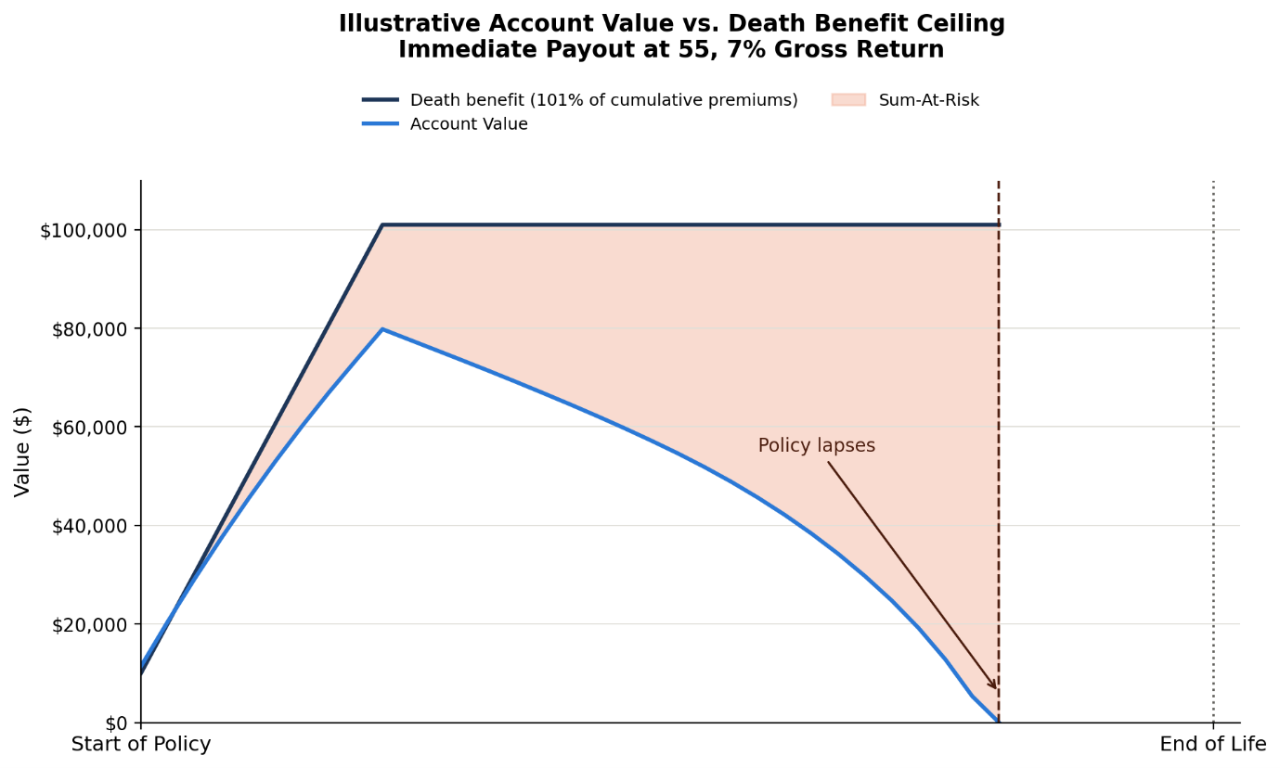
Source: MoneyOwl. Illustration assumes ILP premiums of $10,000 per year for 10 years from age 55; a 7% gross return every year; a fund-level expense ratio of 1.5% p.a.; a dividend payout of 7% p.a.
COI rates in ILPs increase for every year you age. At age 85, the COI rates among four popular ILPs range from 7.2% to over 10%. At 90, this balloons to as much as 16%.
Cost of insurance for various ILPs expressed as a percentage of sum-at-risk for a male non-smoker. Source: Various ILPs’ Product Summaries and Policy Illustrations; MoneyOwl
The circular effect of rising insurance costs and falling investment value
On top of potentially higher sums-at-risk and escalating COI rates, there is a further circular effect – COI is charged through the deduction from your investment units, which further reduces the value of your investment account.
That, in turn, increases the sum-at-risk. This creates a vicious downward spiral for retirees invested in an ILP that is losing value.
Together, these factors mean that you may receive significantly lower retirement income as you lose investment value at a fast pace – right at the ages when you may be facing higher costs.
This matters because Singaporeans are living longer. A 55-year-old today can expect to live to age 85.4 on average, and more than a third can expect to live past 90.
But even if you were willing to “live poor to die rich”, the policy may lapse if the remaining investment value can no longer cover the rising insurance costs. This not only leaves you without the income, but your family also does not receive the full death benefit you had paid for.
Why CPF LIFE was designed with your retirement income in mind

The priority in any retirement income solution should be a solid and stable retirement income stream for as long as you live.
A safe and stable retirement income stream with CPF LIFE
It is important to understand that CPF LIFE is not an investment product. It is a national longevity insurance annuity scheme, backed by a AAA-rated Government, to lower the risk of outliving one’s savings because of longevity.
Because of these unique strengths, CPF LIFE can provide a high annuity payout rate of up to 7% of the premium and keep payouts stable throughout a long retirement.
*Calculations of annual payouts and annuity payout rate are by MoneyOwl. All other figures are from CPF Board. Monthly payout figures are based on a male member on the CPF LIFE Standard Plan.
Think carefully before risking your retirement security
Before withdrawing your CPF savings to place into an ILP, consider the following questions carefully:
1. Can I accept that my retirement income may fall with the value of my retirement savings?
CPF LIFE: CPF LIFE is not exposed to investment risks or volatility.
CPF LIFE premiums are invested in Special Singapore Government Securities and payouts are backed by the Singapore Government rather than the performance of investment markets.
ILPs: Dividend payouts may fluctuate.
ILP premiums are invested into unit trusts or “sub-funds”, which are subject to various investment risks. The value of your investment rises and falls with the performance of these funds.
If a fund pays out more than it earns, part of the distribution may come from the investor’s capital. This can reduce the investment value and leave the investor with less income later in retirement.
Payouts in years of market downturn can cause further depletion of investment value.
2. Do I want my retirement income to last for as long as I live?
CPF LIFE: CPF LIFE provides a stable stream of retirement income for as long as you live.
Payouts continue even after the premium you have set aside is exhausted, through the pooling of interest across members.
ILPs: Dividends from ILP sub-funds are not guaranteed.
If the remaining investment can no longer cover the insurance charges, the policy may lapse, stopping all dividend income.
3. What fees and charges apply, and how might they affect my returns?
CPF LIFE: CPF incurs relatively minimal expenses in maintaining the Lifelong Income Fund, due to the large pool of CPF LIFE members, and there being no marketing and agent commission costs.
ILPs: ILPs charge fees for managing investments, distribution and insurance-related services.
COI rates for ILPs with a 101-type death benefit may increase exponentially at older ages and can significantly reduce the value of your investment.
4. What will my beneficiaries receive when I pass away?
CPF LIFE: Upon your passing, the remaining CPF LIFE premium balance and any remaining CPF account balances will be paid to your beneficiaries.
ILPs: A 101-type ILP may provide a minimum death benefit of 101% of the premiums paid, if the policy is in force at the time of your passing.
However, if the investment value falls and can no longer cover the insurance charges, the policy may lapse, and there will be no more death benefit.
Information in this article is accurate as at the date of publication.
Chuin Ting Weber and Ernest Tham are, respectively, CEO/Chief Investment Officer and Financial Planning Solutions Specialist at MoneyOwl. MoneyOwl is a financial advisory firm and social enterprise.
While reasonable care has been taken on the information used for illustration, the authors and MoneyOwl cannot guarantee its accuracy or completeness. This article and the views contained within should not be construed as financial advice to buy or surrender any insurance or investment product.
This publication has not been reviewed by the Monetary Authority of Singapore.